
Reviewed · WASHINGTON DC AFRICAN AMERICAN HISTORY TOURS
African American History Tour with Museum of African American History Ticket
Washington’s monuments tell only part of the city’s story. This tour connects familiar landmarks to the people who built, challenged, and changed the capital, from enslaved laborers at the Capitol to Marian Anderson’s landmark concert at the Lincoln Memorial. Kenny is a guide associated with the tour, and the experience pairs his stories with time at key sites and a ticket to the National Museum of African American History and Culture.
I like two things in particular: the route reaches beyond the National Mall into neighborhoods such as LeDroit Park, and the guide explains why each monument matters to African American history rather than treating it as a photo stop. The main caveat is that some house visits depend on the day, and the half-day tour moves quickly through a lot of history.
What to know before you book
- A story-led route: Hear about enslaved workers who helped build the Capitol and White House, the Marian Anderson concert, and the March on Washington.
- Neighborhoods beyond the Mall: The route includes LeDroit Park, Howard University, Dunbar High School, and the Howard Theatre, with some sites viewed from the vehicle.
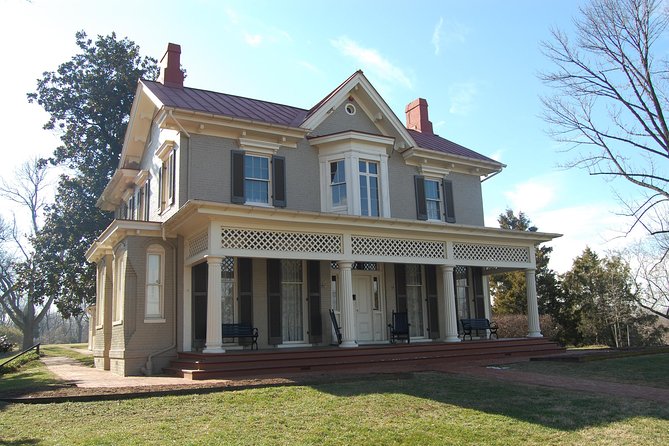
- Home visits vary by day: The Frederick Douglass home is included as a walking visit on Tuesday, Wednesday, and Saturday. The Mary McLeod Bethune house may be visited Thursday through Saturday, time permitting.
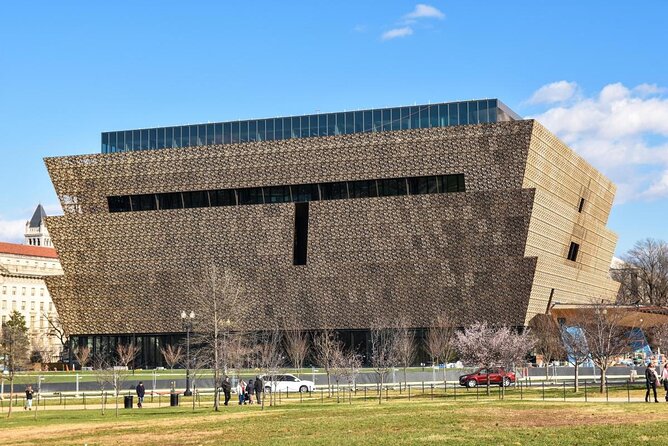
- Museum ticket included: The tour ends at the National Museum of African American History and Culture, where you can remain until closing at 5:30 p.m.
- Small group, vehicle-based: The maximum group size is 21. An air-conditioned vehicle and bottled water are included, with short walks at the stops.
- A brisk half-day: At $90 per person, the price includes the museum ticket and transport, but the tour itself offers an overview, not a full visit to every site.
A half-day that puts African American history in the foreground
The tour starts at 9:30 a.m. at the U.S. Navy Memorial Plaza and lasts about three and a half hours. It covers major national landmarks as well as places tied to Black education, politics, music, and civil rights. That mix is useful if you have limited time in Washington and want more context than a standard monuments loop provides.
The vehicle matters. The route reaches places beyond the central Mall, including LeDroit Park and the area around Howard University, without asking you to walk the full distance between them. You should still expect to get out for several stops, and one account notes that the Frederick Douglass house involves stairs. Bring shoes you can walk in, and be ready for outdoor time at the memorials.
The group can have up to 21 people, so this is small-group touring by bus standards, but not a private outing. The format gives you a guide to ask questions and keeps the route manageable, while the vehicle allows the tour to cover more ground than a walking tour could in the same time.
More museum tours around Washington DC:
- Guided African American History Tour with Reserved Museum Entry
★ 4.5 · 1,180 reviews - Washington DC: Museum of the Bible General Admission
★ 4.8 · 494 reviews - Smithsonian Museum of Natural History – Exclusive Guided Tour
★ 5.0 · 446 reviews
From the Capitol to the White House
At the Capitol, the guide connects the building’s familiar facade to the enslaved people who helped construct it. You also hear about Supreme Court decisions made when the Court met in the Capitol, and their long effect on people of color. The stop lasts about 20 minutes, enough for an introduction, a look around, and photos, but not a full exploration of the building.
The tour also points out where Barack Obama’s inauguration took place. That detail links the symbolism of the Capitol to a modern milestone, while the stories of enslaved labor make clear that the nation’s political center has a much older and more difficult history.
The White House stop lasts about 15 minutes and is outside; admission is not included. The guide places African Americans in the building’s story, from enslaved workers involved in its construction to Obama’s presidency. It is a short visit, so expect interpretation and exterior viewing, not an interior tour.
Nearby, the route includes the headquarters of the National Council of Negro Women at 633 Pennsylvania Avenue NW. Founded by educator and civil rights leader Mary McLeod Bethune in 1935, the organization has worked to advance the rights and welfare of Black women and families. It has been based in the historic building since 1953. The building itself began as a late-19th-century commercial office, a reminder that the city’s history is often written into ordinary-looking streets and buildings.
Constitution Hall and the Lincoln Memorial
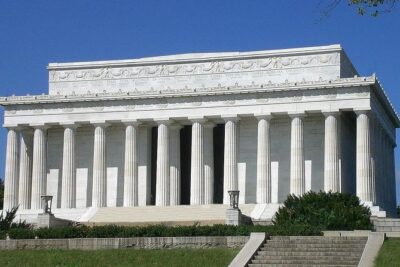
The stop at the Lincoln Memorial gives the tour’s civil rights history a particularly clear setting. The guide discusses the March on Washington and other events held at the memorial, including Marian Anderson’s 1939 concert on its steps. Anderson had been barred from performing at Constitution Hall because of her race. With help from First Lady Eleanor Roosevelt, she sang at the Lincoln Memorial instead, before a crowd of about 75,000.
That story makes the memorial more than a monument to Lincoln. It becomes a stage where the struggle over who could enter, perform, and be heard played out in public. The stop lasts about 30 minutes, the longest listed memorial visit, which gives you time to take in the site and listen without having to rush straight back to the vehicle.
The tour also mentions Robert Moton, who delivered the dedication speech at the Lincoln Memorial’s opening. This is the sort of detail that gives the landmark a broader cast of historical figures than you might encounter on a monuments-only tour.
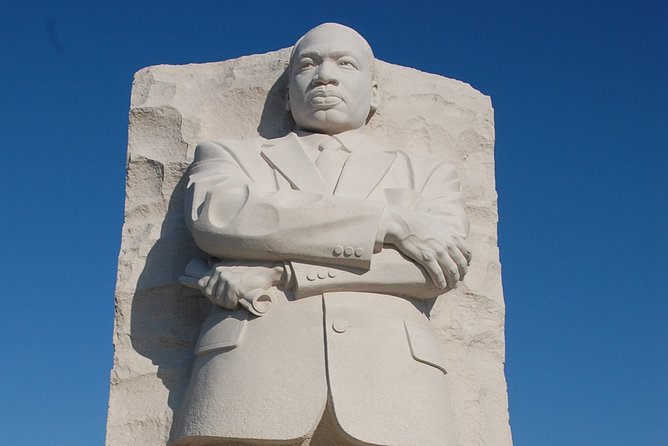
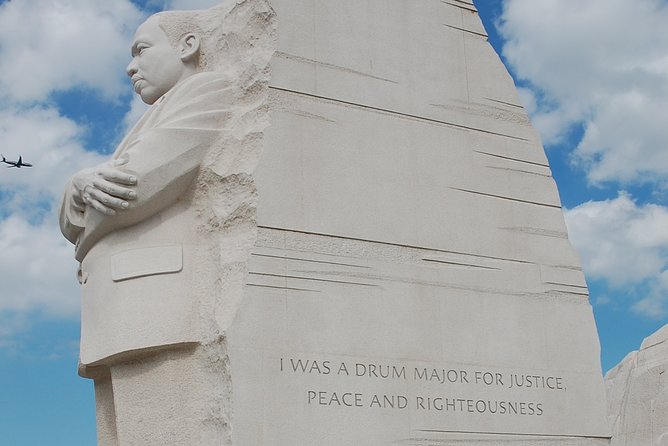
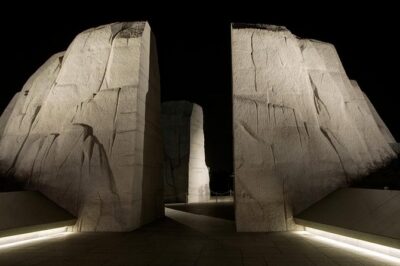
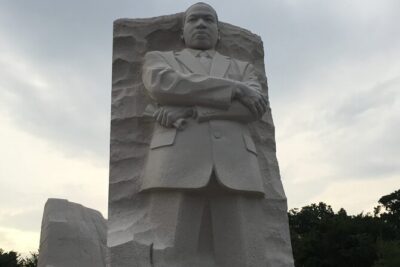
The Martin Luther King Jr. Memorial follows, with about 15 minutes at the site. The guide explains the memorial’s Stone of Hope, Mountain of Despair, and the 14 quotations on its Inscription Wall, along with details about its creation. It is a compact stop, but the guide’s framing can help you read the design rather than simply take a photograph and move on.
The Frederick Douglass home and neighborhood history
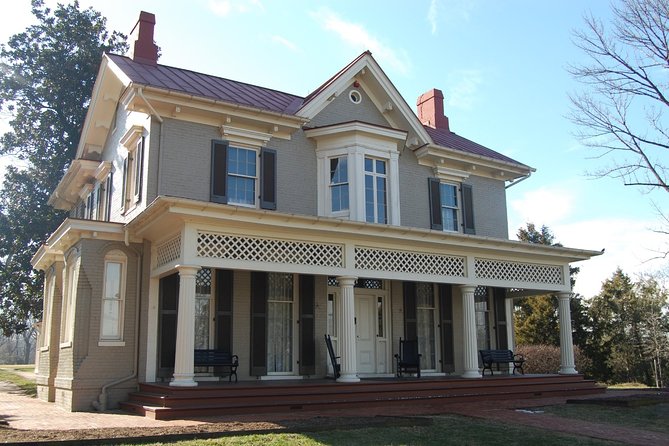
The Frederick Douglass National Historic Site is a highlight for anyone interested in the life of the abolitionist, writer, and statesman. On Tuesday, Wednesday, and Saturday, the tour includes a walking visit inside his home. On other days, the vehicle passes the house while the guide explains its history. The distinction is important: if seeing the interior is a priority, choose your day with care.
The house visit is listed at about 20 minutes. That is enough to make the place tangible, but not a long, unhurried tour. Expect some walking and steps. When the interior visit is not available, the drive-by still places Douglass’s life in the city’s geography, though it is naturally a less direct experience.
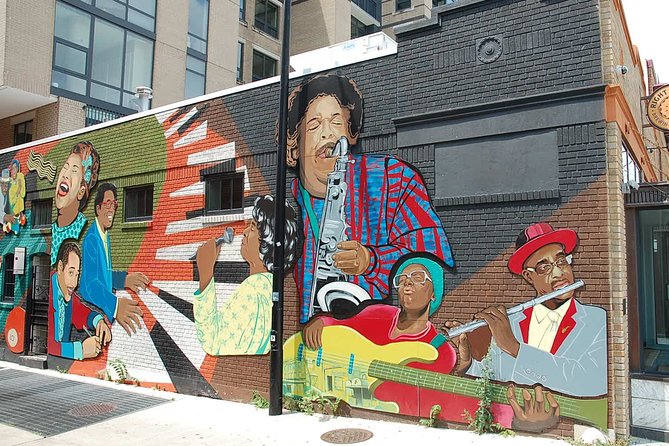
The route also includes LeDroit Park, a neighborhood built initially for white Howard University professors. It later sold homes to both Black and white buyers, making it one of Washington’s early integrated neighborhoods. Mary Church Terrell, a leading organizer and first president of the National Association of Colored Women, lived there. The area was also known as Black Broadway for its early-20th-century theaters, clubs, and music venues, and was home to Duke Ellington.
This neighborhood section is one of the tour’s strengths. You see that African American history in Washington is not confined to monuments and museums. It is also held in residential streets, schools, performance spaces, and the institutions that helped Black communities build cultural and political life.
More African American history tours around Washington DC:
- Washington, DC: African American History Tour & Museum Entry
★ 4.9 · 312 reviews - Washington DC: Walking Tour and African American Museum
★ 4.6 · 157 reviews - Washington DC: African American History Museum Private Tour
★ 4.7 · 54 reviews - DC Landmarks Walking Tour + African American Museum Admission
★ 4.5 · 34 reviews
Civil War service, schools, and music
At the African American Civil War Memorial and Museum, the guide discusses the roughly 209,000 Black troops and sailors who served in the Civil War. The memorial, dedicated in 1998, includes plaques bearing the names of United States Colored Troops in 166 regiments. You can also see the Spirit of Freedom, a sculpture by Ed Hamilton. The stop is listed at about 10 minutes, so take time to look closely at the plaques if this subject matters to you.
Dunbar High School adds another chapter. Founded in 1870 as the first public high school for African Americans in the United States, it became an important center of education and achievement. The school’s history is connected to figures including educator Mary McLeod Bethune and poet Paul Laurence Dunbar. The route also passes Howard University, founded in 1867, whose graduates include Thurgood Marshall, Toni Morrison, and Taraji P. Henson.
The Howard Theatre brings the city’s performance history into view. Opened in 1910, it was designed and operated by African Americans and became a major venue for Black performers during segregation. Duke Ellington, Billie Holiday, Ella Fitzgerald, and Marvin Gaye performed there. Its place on the route helps connect Washington’s political and educational history with the music and comedy that shaped its cultural life.
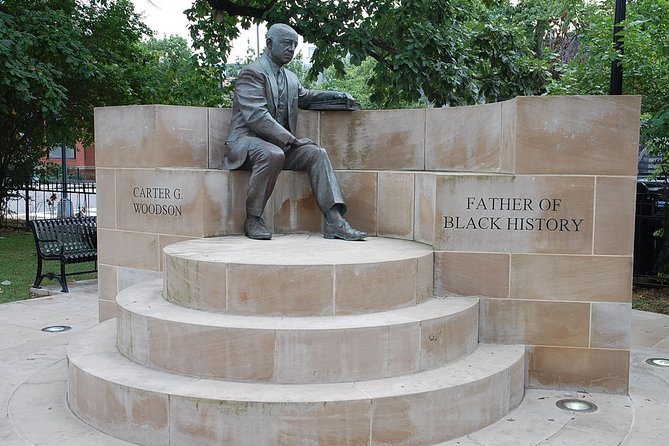
You may also pass the Carter G. Woodson House. Woodson, often called the Father of Black History, was a historian and scholar credited with creating Black History Month. Several of these stops are drive-bys rather than interior visits, so think of them as a guided city overview, not a string of museum entries.
Bethune’s council house and the day-by-day difference
The tour passes the Mary McLeod Bethune Council House, where Bethune bought a home in 1943. The house’s Second Empire design is a detail to watch for as the guide explains Bethune’s work and the organization she founded. On Thursday through Saturday, the tour may stop for a visit inside, time permitting. On other days, the house is viewed from outside.
That schedule overlaps with the Frederick Douglass visit in a useful but slightly complicated way. Tuesday, Wednesday, and Saturday are the listed days for a walking visit inside the Douglass home. Thursday through Saturday may include the Bethune house, while Sundays and Mondays are listed as days when both homes are closed. Saturday is the only day specifically listed for both house visits, but the Bethune stop remains subject to time. Confirm the day’s expected visits before booking if either interior is a priority.
This is a real planning point, not a minor footnote. The two homes provide distinct perspectives on Black leadership and institution-building, but the route cannot promise both interiors on every departure. The broader tour still visits many sites, yet your exact experience changes with the calendar.
Ending at the African American history museum
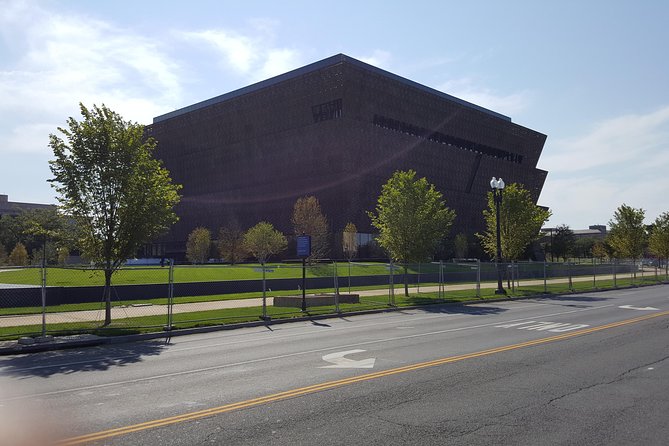
The tour ends at the National Museum of African American History and Culture, at 1400 Constitution Avenue NW. Admission is included, and the ticket is for the same day. The listed museum portion is about an hour, but you can stay inside until the museum closes at 5:30 p.m. Once you arrive at the museum, the guided tour is over.
I would treat that ticket as a starting point, not a full museum visit. The museum covers far more than you can absorb in an hour, and the tour’s own guide notes that beginning on the lower level is important. If the museum is a central reason for booking, leave the rest of your day open so you can continue at your own pace.
This ending is a practical strength: you finish at a major museum rather than needing to travel across town for the next part of your day. It also gives the morning’s outdoor landmarks a thoughtful follow-up indoors. Just remember that the group tour does not guide you through the museum after arrival.
Is $90 a fair price?
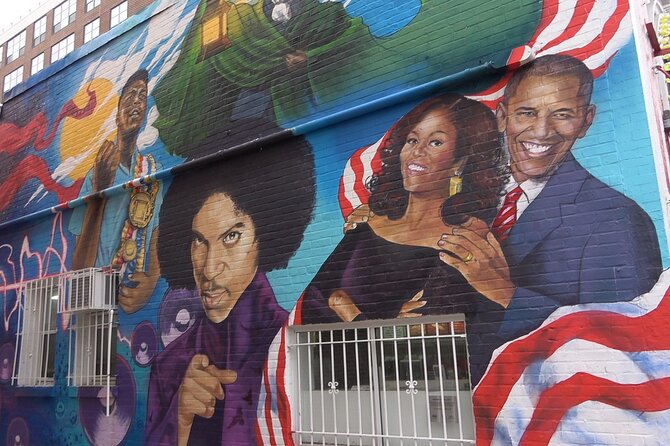
At $90 per person, the value depends on what you want from a Washington tour. The price includes a museum ticket, bottled water, and air-conditioned transportation, as well as a guide who ties together sites that would take planning to reach independently. If you value the commentary and the chance to visit places outside the Mall, the cost is easier to justify.
It is less compelling if you want long visits at each landmark or a full guided museum experience. Several stops are brief, and some sites are viewed from the vehicle. The tour is designed to give you a connected overview in half a day, not to replace a dedicated visit to the Capitol, a house museum, or the African American history museum.
The tour is offered in English, and a mobile ticket is provided. Confirmation is received at booking. Service animals are allowed, and the activity is described as suitable for most people, though walking and steps are part of some visits. Free cancellation is available until 24 hours before the start time; cancellations within 24 hours are not refunded. Poor weather or failure to meet the minimum group size can lead to a different date or a full refund.
Who should book this tour?
I’d choose this tour if you want a guided introduction to African American history across Washington, especially if you are new to the city or want to connect the monuments with stories that are easy to miss on your own. It suits families too: the vehicle limits the amount of walking between distant sites, and the stories can give younger visitors a clear sense of why these places matter.
Book it with realistic expectations. You will see a lot, but you will not spend long at every stop, and the house visits depend on the day. If you want a compact, engaging route that finishes at the National Museum of African American History and Culture, $90 buys a useful mix of transport, interpretation, and admission. If the museum itself is your main goal, plan to stay well beyond the tour’s scheduled end.
FAQ
How long is the tour?
The tour lasts about three hours and 30 minutes, with a 9:30 a.m. start time.
Where does the tour start and end?
It starts at the U.S. Navy Memorial Plaza, 701 Pennsylvania Avenue NW, and ends at the National Museum of African American History and Culture.
Is museum admission included?
Yes. The tour includes a same-day ticket to the National Museum of African American History and Culture.
How long can I stay at the museum?
You may stay until the museum closes at 5:30 p.m. The guided tour ends when you arrive at the museum.
What days can I visit the Frederick Douglass home?
The tour includes a walking visit inside the home on Tuesday, Wednesday, and Saturday. On other days, the vehicle passes the house and the guide explains its history.
Can I visit the Mary McLeod Bethune house?
The tour may visit the house Thursday through Saturday, time permitting. On other days, it passes the house.
What is included in the $90 price?
The price includes a ticket to the National Museum of African American History and Culture, bottled water, and transport in an air-conditioned vehicle.
How large is the tour group?
The maximum group size is 21 people.
What is the cancellation policy?
You can cancel at least 24 hours before the tour for a full refund. Cancellations or changes made less than 24 hours before the start time are not accepted, and the amount paid is not refunded.
More history tours around Washington DC
- DC Monuments & History Guided E-Cart Tour-Blankets
★ 4.5 · 450 reviews - Historic Georgetown: History, Gossip, & Architecture Walking Tour
★ 5.0 · 321 reviews - DC’s Original Food and History Walking Tour
★ 5.0 · 255 reviews - Smithsonian Museum of American History Exclusive Guided Tour
★ 5.0 · 245 reviews
New on the list in Washington DC
- Washington, DC: Thanksgiving Day Lunch Cruise★ 4.7 · 3 reviews
- White House at Night: Scandals & Murder Adults Only Tour★ 4.5 · 4 reviews
- Washington DC: Private Custom Tour with a Local Guide★ 4.9 · 4 reviews
- Washington Monument Ticket & National Mall Memorials Tour★ 5.0 · 16 reviews
- Washington DC: Highlights Guided Walking Tour★ 4.6 · 6 reviews
- Thomas Jefferson Monticello Small Group Day Tour from DC★ 4.8 · 16 reviews
- Washington: Mt. Vernon, Alexandria & Arlington Cemetery Tour★ 3.4 · 8 reviews
- Washington, DC: The Good Liar: Brian Curry★ 5.0 · 3 reviews
Washington DC African American History Tours, compared.
Guided African American History Tour with Reserved Museum Entry
Read our review →
DC Landmarks Walking Tour + African American Museum Admission
Read our review →
Private Black History Tour Washington DC for up to 10 Guests
Read our review →
Walking Tour of Still’s Underground Railroad in Alexandria
Read our review →Browse the lists this tour appears in