

Reviewed · WASHINGTON DC
Washington DC Neighborhoods Personalized Self-Guided App Tour
Washington DC’s best story here is the way its landmarks connect: a grand train station, the institutions of Capitol Hill, a former president’s neighborhood and a home tied to Frederick Douglass all appear on one self-guided route. At $5 for a group of up to 15, the price is unusually low, and the route ends inside the Library of Congress, one of the city’s great public buildings.
I like two things in particular: the mix of national history with places that feel more local, such as the Florida House and Obama’s former neighborhood, and the freedom to explore with your own group rather than join strangers. The main caution is that this depends on the app working well. One detailed account describes trouble connecting, and the Library of Congress requires a timed reservation that should be arranged before you set out.
What to know before you set out
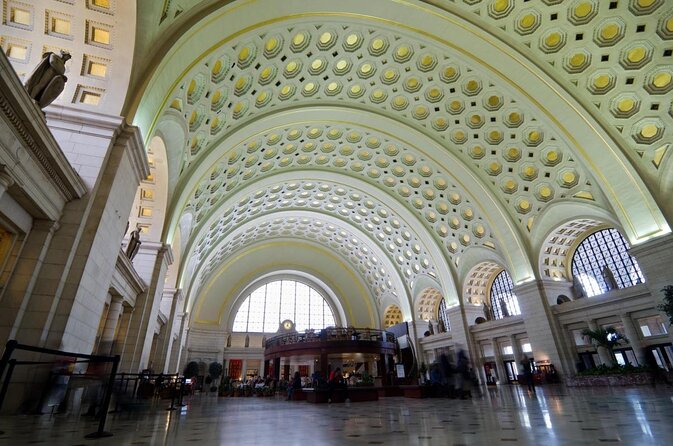
- Union Station opens the story: Allow about 30 minutes for the station’s architecture and its role in Washington’s development.
- Capitol Hill is the route’s historical core: The Supreme Court, the Capitol, the Library of Congress and a stop tied to Thurgood Marshall bring government and civic history into view.
- The route adds personal stories: Frederick Douglass’s home and the neighborhood associated with former President Obama broaden the focus beyond federal buildings.
- The group price is $5 for up to 15 people: That is inexpensive, but the experience’s value depends on the app delivering useful commentary.
- The Library needs advance planning: The route ends inside the Library of Congress, but a timed reservation is required for entry.
- The overall rating deserves caution: The experience is rated 3.7 from three reviews, too small a sample to establish a reliable pattern of praise.
A city story that starts at Union Station
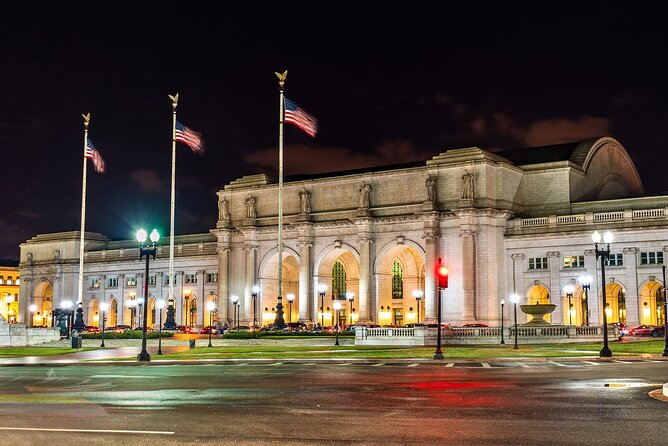
Union Station is a fitting place to begin. Designed by architect Daniel Burnham, it opened on October 27, 1907, and was completed in April 1908. The station was one of the country’s first major union railroad terminals, and the app’s opening section is meant to explain how it shaped Washington and its place in national history.
Give this stop time. About 30 minutes is assigned to it, longer than most of the named stops, and that makes sense: the building is both a working station and a major piece of the tour’s historical framing. If you arrive with only a few minutes to spare, you may miss the chance to take in the architecture and listen without rushing.
The route begins at 50 Massachusetts Avenue NE. From there, it moves toward Capitol Hill and other sites, ending at the Library of Congress. The tour is described as taking about two to four hours, so your pace and how long you spend at each stop matter. There is no single fixed pace imposed by a live group leader, but you are still relying on the app to guide you from place to place.
That distinction is important. This is a self-guided app tour, not a conventional walking tour with a person leading the way and answering questions in real time. The supplied descriptions refer to what a guide will explain, but the product is identified as self-guided. No guide’s name or details about an in-person guide are provided, so book expecting app-based guidance rather than a scheduled meeting with a named historian.
More self-guided options around Washington DC:
- Visit Mount Vernon by Bike: Self-guided Ride with Optional Boat Cruise Return
★ 4.5 · 65 reviews - Best of DC: Hop-on Hop-off, Night Tour, and Arlington Audio Guide
★ 4.5 · 64 reviews - Washington DC Monuments Self-Guided Walking Audio Tour
★ 4.5 · 15 reviews
Capitol Hill’s courts, Congress and civic landmarks
Several stops shift the story from Washington’s transportation history to the institutions that shape American government. One is described as the administrative headquarters of the federal judiciary, with commentary about Thurgood Marshall and his contribution to Capitol Hill and the country. The exact site name is not given in the supplied details, so check the app’s route information if you want to know precisely where this stop falls.
The Supreme Court is another central stop. The commentary is intended to cover the Court’s history, how it functions today and its place on Capitol Hill. That combination can help you look beyond the building’s imposing exterior and understand the institution it houses. Still, this is an app-based overview, so it may suit you best as an introduction rather than a substitute for a longer visit focused on constitutional history.
The United States Capitol adds architecture and political memory. The tour promises context about the building and famous speeches delivered there, a useful way to connect its grand scale with the decisions and public debates associated with it. The route does not specify entry to the Capitol, so do not assume that the app tour includes access inside.
A stop at the Belmont Paul Women’s Equality Monument brings a different chapter of civic life into the route. The building served as the National Woman’s Party headquarters and is maintained by the National Park Service. Its connection to the suffragists’ campaign for voting rights gives you a focused place to consider how political change has been won outside the halls of government.
This is one of the route’s strengths on paper: it does not limit the story to presidents and institutions. A stop devoted to women’s suffrage adds voices and organizing efforts that can be overlooked when a Capitol Hill visit becomes only a tour of official buildings. The available details do not say how much time is assigned to this stop, so you may need to make your own decision about how long to pause.
A personal side of the capital
The Frederick Douglass National Historic Site is a notable change of scene. Here, the app is meant to discuss Douglass’s life, his former home and his connection with President Ulysses S. Grant. The listed stop takes about 15 minutes, and admission is shown as free.
That short time may work for a quick introduction, especially if you are fitting several sites into one outing. If Douglass’s life is a major reason you are taking the tour, you may want more time than the route’s estimate allows. The provided information does not explain whether the app’s 15 minutes includes time inside the house, or whether the visit is focused on the surrounding site, so check the current access details before planning around an interior visit.
The tour also points out the Washington neighborhood where former President Obama lived and promises stories about his time there. That can add a contemporary layer to a route otherwise dominated by older institutions and monuments. The exact address and amount of time for this stop are not provided, so the description gives you a subject, but not enough detail to judge how substantial the stop will be.
The Florida House is another unusual entry. Described as the only state embassy in Washington, it offers a chance to learn why it exists and how it functions today. The stop is assigned about 20 minutes, with no admission charge listed. If you are from Florida, the description mentions extra benefits, though it does not spell out what those are. Ask or check ahead rather than counting on a particular service.
These stops help the route feel broader than a procession of monumental facades. You get a former president’s neighborhood, a site connected to a leading abolitionist and a state’s presence in the capital. The tradeoff is that the route’s less familiar locations may depend more heavily on the quality and clarity of the app’s commentary. If the app fails to load, a short stop can become hard to interpret.
The Folger and the Library of Congress
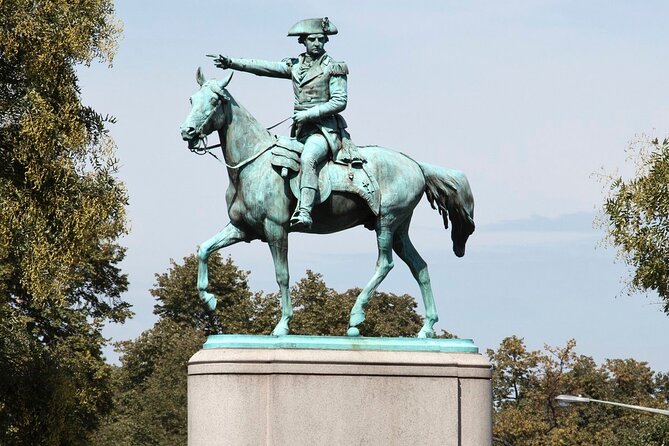
The Folger Shakespeare Library is described as the world’s largest Shakespeare library. The planned stop is about 20 minutes, with admission shown as free. The app is meant to offer context about the library’s place on Capitol Hill and Shakespeare-related facts.
This is a good thematic pause between political sites. It brings literature and collecting into a route otherwise centered on government and public history. But 20 minutes is brief, and the information provided does not promise entry or describe an interior visit. Treat it as an introduction to the institution, not a full library visit.
The final stop is the Library of Congress, where the tour ends inside the building at 101 Independence Avenue SE. About 45 minutes is allotted, and the commentary is meant to cover the Library’s history and notable holdings. Ending here gives the route a satisfying destination: a national institution devoted to books, records and knowledge, rather than another stop on the way to somewhere else.
There is an important practical catch. A detailed account describes arriving without a timed reservation and being unable to enter. The Library is free, but free admission does not mean you can simply walk in at any time. Make a reservation before you start the tour, and confirm the entry requirements for your date. The tour’s stated ending inside the Library depends on your being able to get through the door.
The displayed tour hours run from 6:00 a.m. to 11:00 p.m., every day, for the date range provided. Do not confuse those hours with the Library’s visitor hours. The data does not say that the Library itself is open for the entire tour window, so check its current schedule and book an entry time that fits your route.
More guided tours around Washington DC:
- Washington DC in One Day: Guided Sightseeing Tour
★ 4.5 · 3,360 reviews - Washington DC “See the City” Guided Sightseeing Segway Tour
★ 5.0 · 1,924 reviews - Small-Group Guided Tour inside US Capitol & Library of Congress
★ 5.0 · 1,869 reviews - See DC In A Day: Guided Small Group Ultimate Day Tour
★ 5.0 · 1,257 reviews
What $5 buys, and what it does not
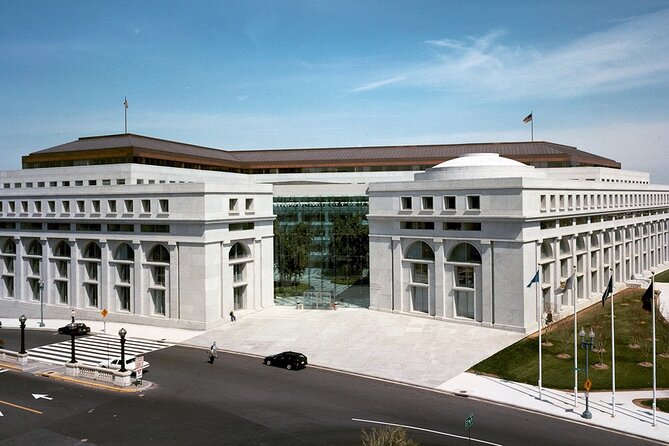
At $5 per group, the price is a bargain if the app works and your group uses it together. The booking covers up to 15 people, so a family or a small group of friends can share the cost rather than paying per person. You also have the freedom to pause, move at your own pace and focus on the stops that matter most to you.
But low cost is not the same as guaranteed value. A detailed one-star account describes an unsuccessful attempt to get the app’s guide to continue after a brief introduction, trouble reconnecting, and difficulty starting manually. The same person found requests to connect to a music library distracting. That is a single experience, not proof that the app will fail for you, but it points to a real risk: an inexpensive digital tour is only useful if the audio and navigation are clear and dependable.
The overall rating is 3.7 from just three reviews. That small number cannot support a confident claim that the tour consistently succeeds or fails. There are no clearly established, repeatedly praised features in the available feedback, so I would not book on the assumption that other people have verified the app’s quality. Instead, weigh the very low group price against the possibility of technical friction.
Before you leave Union Station, confirm that the app is installed and that you can access the tour. The complaint about connection problems makes this a sensible precaution, though the supplied information does not specify whether the app works offline. Do not assume it will. If you run into trouble, the account suggests that switching to manual use may not necessarily solve the problem.
The route is booked on average five days in advance, but that is not a required lead time. The booking confirmation is provided at the time of purchase. Free cancellation is available until 24 hours before the start; cancellations inside that window are not refunded, and changes made less than 24 hours before the experience are not accepted.
Who should consider booking
This works best if you want a low-cost, private outing that links several kinds of Washington history, and you are comfortable letting an app set the pace. It can suit a group of up to 15 that wants to share one booking, especially if members are happy to explore at different speeds and do not need a live guide to answer questions.
It may be less suitable if you want a guaranteed personal guide, detailed access arrangements for every building, or a fully dependable audio experience. The tour’s description does not name a guide, and the app problem described in one account makes it wise to have a backup plan. You should also be willing to arrange the Library’s timed reservation separately before setting out.
I would book it if the low group price matters, the route’s mix of political, literary and personal history appeals to you, and you can verify your Library entry and app access in advance. I would skip it if you need a live guide or would be frustrated by troubleshooting on the street. Its route is promising; its value rests on the technology working and your planning around the Library.
FAQ
How much does the tour cost?
The price is $5 per group, with up to 15 people included.
How long does the tour take?
The estimated duration is two to four hours.
Is this a private tour?
Yes. It is listed as a private activity, and only your group participates.
What language is offered?
The tour is offered in English.
Where does the tour start?
It starts at Union Station, 50 Massachusetts Avenue NE, Washington, DC 20002.
Where does the tour end?
It ends inside the Library of Congress at 101 Independence Avenue SE, Washington, DC 20540.
Do I need a reservation for the Library of Congress?
Yes. A timed reservation is required for entry, so arrange one before you begin the tour.
Is admission included at the stops?
Union Station and the Library of Congress are marked as including admission. The Frederick Douglass National Historic Site, Folger Shakespeare Library and Florida House are marked as free. The Library itself is free, but it requires a timed reservation.
Can I cancel for a refund?
You can receive a full refund if you cancel at least 24 hours before the start time. Cancellations made less than 24 hours before the experience are not refunded.
How far ahead is the tour usually booked?
It is booked about five days in advance on average, though the information does not state that you must book that far ahead.
New on the list in Washington DC
- Washington, DC: Thanksgiving Day Lunch Cruise★ 4.7 · 3 reviews
- White House at Night: Scandals & Murder Adults Only Tour★ 4.5 · 4 reviews
- Washington DC: Private Custom Tour with a Local Guide★ 4.9 · 4 reviews
- Washington Monument Ticket & National Mall Memorials Tour★ 5.0 · 16 reviews
- Washington DC: Highlights Guided Walking Tour★ 4.6 · 6 reviews
- Thomas Jefferson Monticello Small Group Day Tour from DC★ 4.8 · 16 reviews
- Washington: Mt. Vernon, Alexandria & Arlington Cemetery Tour★ 3.4 · 8 reviews
- Washington, DC: The Good Liar: Brian Curry★ 5.0 · 3 reviews